Port Washington: Fact-checking the mayor’s fact-checking
After a contentious approval of Port Washington’s Tax Increment District to support the city’s massive data center construction, the mayor distributed the 2-page flyer below to fact-check the community criticisms that he has heard.
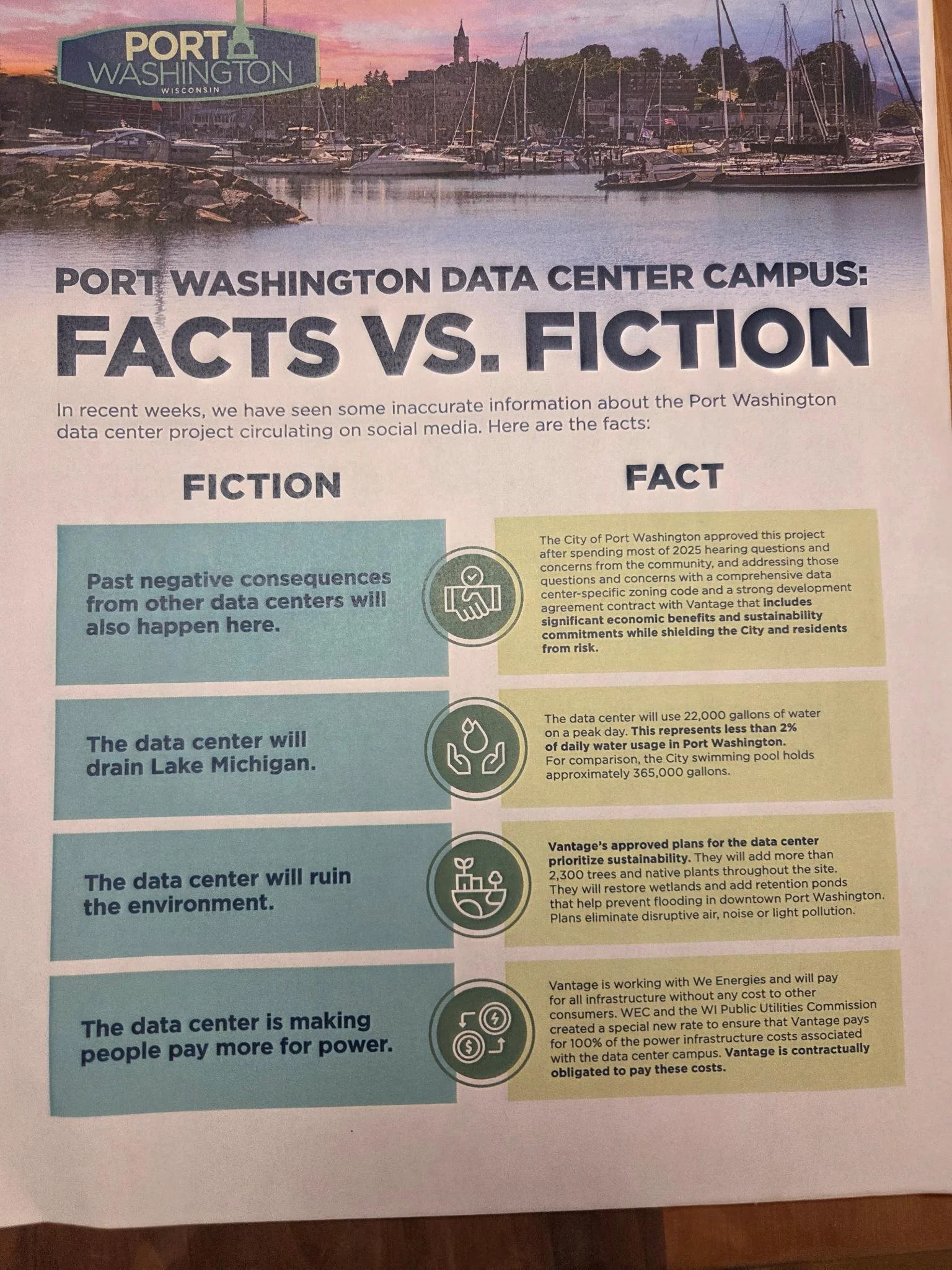
Let’s fact check the fact check.
Page 1, number 1
“includes significant economic benefits” … that accrue to the city in 2045 in the best case scenario. Yes, PW will see a short term tax revenue bump of about $800K per year because of the TID’s baseline valuation will be defined after the property is revalued after sale. However, all that financial maneuver did was to give the overall TID plan no room for error and a close date of 2045. Maybe the mayor’s definition of significant is different than most?
Page 1, number 2
The “fiction” claim needs to be fact-checked. There are approximately 1.3 quadrillion gallons of water in Lake Michigan. If you don’t know what a quadrillion is, it 1,000,000,000,000,000, or a million million. Now I know there are some crazy people in Port Washington, but I don’t think any of them have claimed the new data center will drain Lake Michigan.
Is 22K gallons per day at peak the right answer? Dunno. I’m sure the mayor will have the big corporation on a short leash and make sure they deliver on that promise.
Projecting a ludicrous statement onto your detractors and then showing how ludicrous the statement falls short of reasonable debate.
Page 1, number 3
Another projection: the data center will ruin the environment. The whole environment? Just the parcel? Whatever the mayor seems to think he heard, let’s check his claims.
2300 trees — never trust a single number. The parcels listed in the TID total 1673 acres. That’s 1.4 trees per acre, not exactly environment-saving stuff. More like “let’s pick a big number and hope nobody does the per acre math.”
He also claims that “plans eliminate disruptive air, noise, or light pollution.” Reality: on 11/20/2025 at the city’s Planning Commission meeting, the developer (ya know, the one with the plans) asked the commission, on which the mayor sits, to allow construction M-F 24x7 and Sa/Su from 6am to 8pm. The mayor said fine. So maybe we should scratch that claim on the mayor’s flyer.
https://www.youtube.com/live/PzouC51F75o?si=t-TpXlqZczC073vd&t=1089
Page 1, number 4
“Vantage is contractually obligated to pay these [electricity infrastructure] costs.” In We Energies’ presentation to the common council where this was stated, there was an important caveat to the obligation: unless the infrastructure could be repurposed. Nobody can predict what will happen in the years to come, but it leaves open the possibility that Vantage can claim there is alternative use of whatever they are leaving behind. Will they use that opportunity? No one knows.
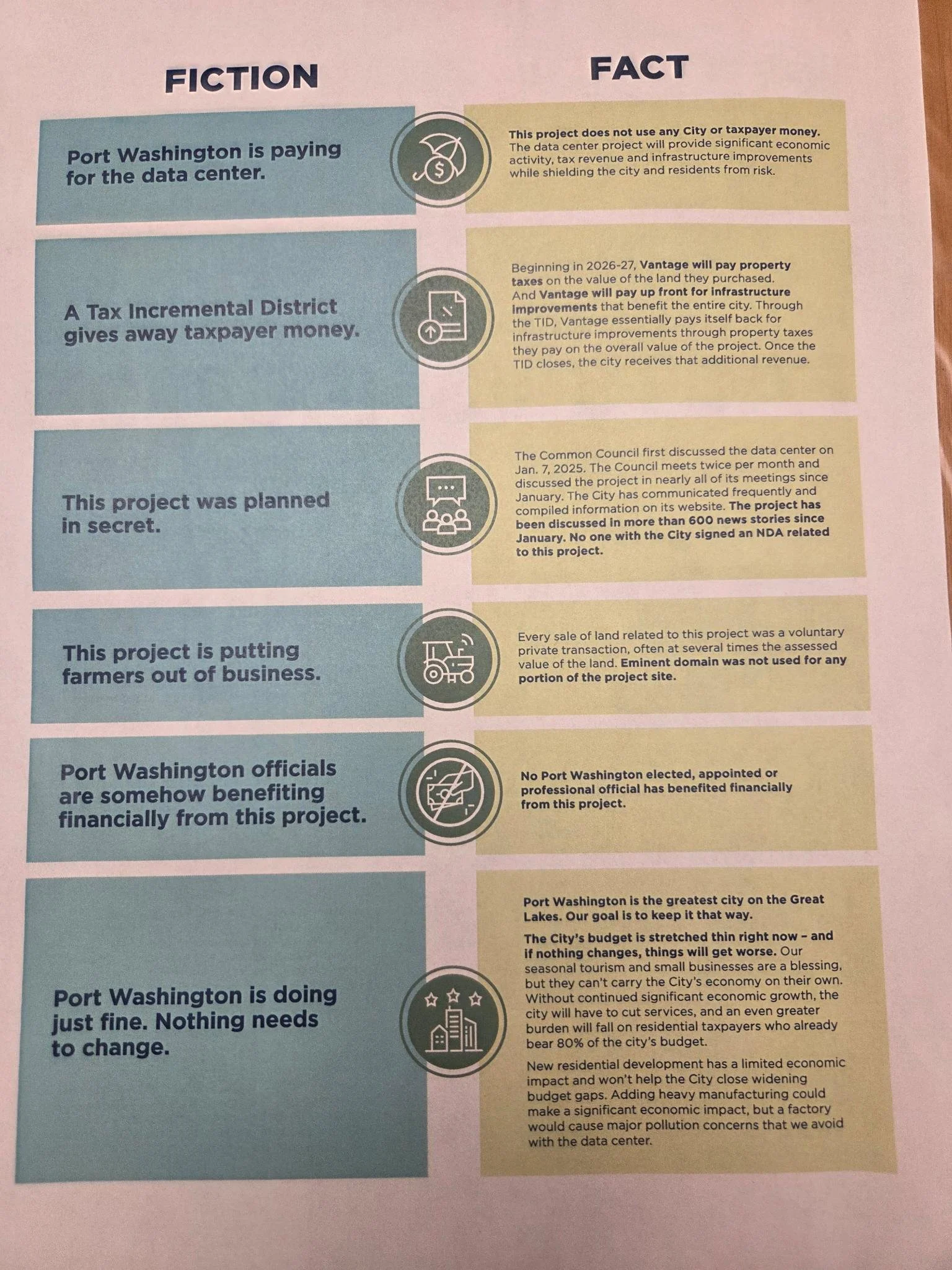
Page 2, number 1
The mayor stridently claims, IN BOLD, “this project does not use any City or taxpayer money.” Either the mayor is purposely misleading you or he does not know how Tax Increment Financing works. A homeowner in PW pays taxes (taxpayer money) that become city money upon collection. A corporation in a TID pays taxes, then gets those taxes refunded to pay for the development activity in the TID. For the mayor to be right, the homeowner’s money is taxpayer money but the corporation’s money is not because the city is giving it back to them. The fact-checking machine says Does Not Compute.
Page 2, number 2
This is my favorite example of “I can’t believe someone really wrote those words and didn’t realize how incredibly ludicrous they sound to normal people.” Let’s say this really slowly and multiple times for effect, mayor’s words from the flyer:
”Vantage essentially pays itself back for infrastructure improvements through property taxes they pay”
”Vantage essentially pays itself back for infrastructure improvements through property taxes they pay”
”Vantage essentially pays itself back for infrastructure improvements through property taxes they pay”
The mayor wants you to think this is some magical financial wizardry that only he understands. No, it’s really exactly what it says: Port Washington is letting them pay off their debts with their own tax payments instead of paying those tax payments to Port Washington.
… you know, just like they let all of you do with your mortgage… er, wait, they don’t do that, do they? Maybe offer to plant more trees next time!
Page 2, number 3
Planned in secret? Let’s give this one to the mayor. The city met all the minimum requirements of the law: small rezoning sign in the grass somewhere, letters to a couple of houses within a certain distance, announcement in a newspaper not many people read any more.
What should he have done? He should have said “this is the most monumental change imaginable for our small city. I don’t care what the legal requirements are, we should proactively engage our community and bring them along every step of the way to make sure they are part of the process able to express their opinions and concerns.”
He didn’t do that.
So the meeting was held in the open, most people were unaware, and he accused the residents of not paying attention.
Page 2, number 4
The rebuttal doesn’t match the assertion, but let’s try to fact check anyway. Every transaction was a private transaction, often at several times the assessed value. Perhaps, but the mayor is also asserting in this TID that the rezoning will result in a massive increase in the valuation that will create a short-term tax revenue windfall for the city. Current assessed value of the parcels is $7.3M (page 14 of TID document). Page 13 says the new post-rezoning value will be $120M.
So Mr. Mayor, did that $112.7M accrue to farmers who owned the land or to the developer? You can’t have it both ways.
Page 2, number 5
Let’s be generous here too. If no official gained personally from the deal, then they just have bad judgment instead of nefarious intent.
Page 2, number 6
Port Washington is financially one foot in the grave. The mayor here is complaining about a legitimate issue, that state law only allows a city’s tax levy to increase by net new construction. If your net new construction number is lower than the inflation rate, your budget’s purchasing power erodes over time. The only alternative, which PW did recently, is a referendum to ask the people for a tax levy increase.
In 2025, PW had a NNC of 1.34%, average for the state, but better than the median of 1.09%.
In 2024, it was 1.71% vs average of 1.36% and median of 1.08%.
In 2023, it was 1.21% vs average of 1.38% and median of 1.04%.
In fairness to the mayor, those %s are lower than inflation. While not every cost in a city’s budget is sensitive to inflation, many are, and the pressure is real to make the budget work under those constraints.
However, if PW is in dire straits, then more than half of the municipalities in the state are in worse shape, which I guess means we’re going to need a lot of new data centers to save us from ruin.
Mayors get elected to make tough decisions. Faced with the decision between tightening the budget and betting everything on a data center, he chose the latter.
Will it work? As long as the 20-year project goes as planned, the economy remains strong enough to support the investment, the AI bubble doesn’t burst, the city doesn’t get embroiled in a legal dispute with the developer, Port Washington will save itself from certain fiscal doom.
In the interim, though, the net new construction in the TID will allow the mayor to raise your taxes as much as he deems necessary.