Economic Benefits are Overstated
Direct jobs, indirect jobs, construction jobs, much needed economic development … what is the truth?

Employment
Construction jobs
Yes, data centers will support a large number of construction jobs. Many of those will be itinerant workers but it is undeniable that there is some direct and indirect benefit during the construction period. And we have already admitted that the construction period is very long. That’s beneficial to employment but not to resident impact.
Data center jobs
Data centers pride themselves on the LOW number of personnel it takes to run them. “Lights out data center” is a compliment in the industry, not a criticism. The Caledonia WI site forecasted 50 jobs for a 244 acre parcel, an extremely low number per acre. Port Washington’s acres per worker is 5.5. (That’s right, acres per worker, not workers per acre.)
Rather than rely on estimates of jobs, let’s look at actual numbers. Northern Virginia has the country’s greatest concentration of data centers. This report from the Northern Virginia Technology Council (a pro-data center group if there ever was one), says on page 18 that “in 2023, data centers throughout Northern Virginia directly provided approximately 10,420 jobs.” Never trust a single number, though. Always look for the other number that puts the number in context.
This link identifies the number of data centers in Northern Virginia as 549. Doing the simple math: 10,420 / 549 = ~20 jobs per data center.
That same link also gives a clue to the real economic engine that data centers provide: “There are currently 64 data centers under construction in Northern Virginia.” It’s not the data centers. It’s the construction. Keep that treadmill going and you’ll see economic development. Stop that treadmill and you fall off the back and crash. Lots of big buildings whose benefits accrue to out of state companies, not a lot of local benefit.
Indirect economic development
Data centers do not attract other development. The operators of data centers brag about data center management being “lights out,” meaning very limited on site staff.
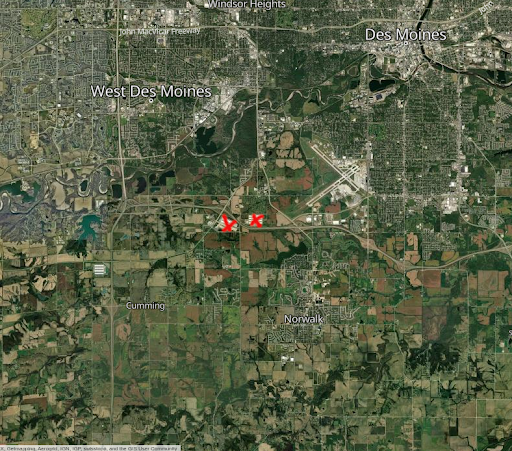
The image here shows Microsoft’s West Des Moines campus. The red X’s in the image mark the data center buildings in the campus whose construction started 17 years ago. Both West Des Moines and Des Moines have been growing during that period, but as you can see from the map, the area around the data center is eerily empty.
With limited staff, new houses don’t get built, restaurants don’t get built, retail shops don’t get built. The infrastructure of even a small city can absorb the permanent addition of 50 new employees.
And… nobody seems to want to live anywhere near the data centers in West Des Moines.
Historically, commercial or large scale residential development was a double-win: the construction work, then the ongoing economic development from the people moving in. Data centers do not have the latter.