What the <bleep> is a TID…
and why should I care?
A tax increment district is a financial tool used very commonly in the state (and across the country) to encourage economic development. With one exception in WI, all data center projects have leaned heavily on this tool in order to finance the deal.
Here are some links to articles describing the tool:
https://www.economicpolicyresearch.org/insights-blog/what-is-tax-increment-financing-tif
https://en.wikipedia.org/wiki/Tax_increment_financing
https://wispolicyforum.org/research/tax-incremental-financing-on-the-rise-how-do-municipalities-use-their-primary-development-tool/
But if you want the For Dummies version, let me explain it this way:
Imagine you wanted to build a house on a vacant lot.
Imagine the local govt being happy about that because it adds tax revenue after construction is complete.
Imagine you said to the local govt: I can’t make this work, my monthly mortgage payment is a little too high for my salary.
Imagine the govt said: No worries, you can use your property tax payment every year for the next 20 years to help take the edge off that mortgage payment. Welcome to the community!
Then imagine getting up off the floor because you couldn’t believe they would do that.
Now imagine being your neighbor, thinking “police and fire and schools are still going to serve that guy and he doesn’t have to pay taxes for 20 years? Huh? Really?”
That’s a TID, albeit oversimplified.
Now substitute “data center” for “house.”
And if you want to really get into the weeds of the sometimes sinister nature of them and how little ol’ normal people pick up the tab, read this article.
Like all financial deals, some of them are good and some of them are bad. If your community has a data center proposal in its early stages, the financial terms are probably still being worked on. If your proposal has moved past the early stages, then there will be a proposal that looks like this document. Understanding this document is the only way to understand how good or bad your proposal is economically to the community. The ones produced so far in WI communities are not favorable, with Port Washington’s being the worst. In an upcoming post, I will break it down and show just how bad it is.
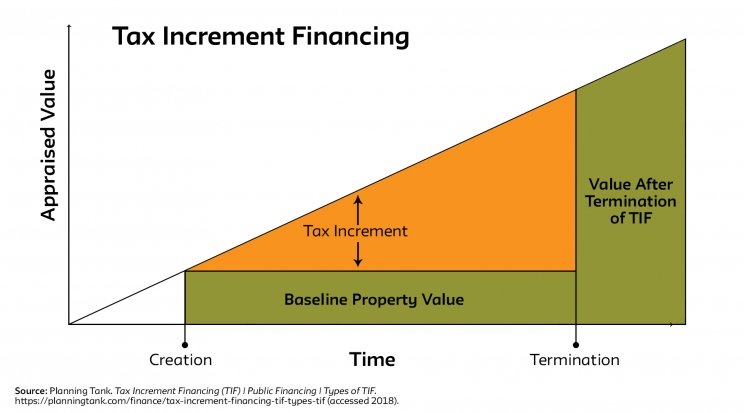
The Theory
We want economic development. Jobs, income, tax revenue, more jobs, more income, more tax revenue. Schools get better, roads get built and paved, police officers get raises, ….
First, there are the construction jobs for a project.
Then, people move in to the new homes or get jobs at the new businesses. Those people pay taxes, shop in stores, and before you know it, it’s all wonderfully self-sustaining.
When the Theory Falls Apart
In the context of a data center, the theory falls apart for a few reasons:
Data centers do not produce many permanent jobs
Data centers do not attract other economic development
Few employees
Equipment largely manufactured out of state or country
Construction economic impact is temporary, eg nobody builds new housing for construction workers, even if the schedule is several years long
In a rural setting, where land is plentiful, no one will build anything near a data center