Madison, we have a problem.
Raise your hand if you support a hyperscale data center in your community if it produces absolutely zero benefit to school districts and doesn’t even lower your school property tax bill.
“No way!” was my response too. That can’t be true. The data center is going to add MILLIONS to the school’s tax coffers. We’ll be able to finally FULLY FUND our local school district.
Yeah, well, read on. Please, someone find an error in what I’ve calculated.

School Funding Mechanics
Your school district’s funding comes largely from two sources: property taxes and state equalization aid.
You know what property tax is. It’s that line item on your tax bill that just seems to keep rising by a lot every year.
Every year, the school district uses the state revenue limit calculation to determine how much they can raise their total spending.
Next, the state calculates how much state aid each school district gets. It’s called “equalization aid” because the goal is to level the playing field. That is, rich school districts get less per student, poor school districts get more. Foreshadowing the problem, guess what the state uses as a proxy for rich v poor?
Once the school district knows its total allowable spending and the amount of state aid, they subtract the latter from the former and get the property tax levy.
Next, the levy is allocated to each taxpayer based on that taxpayer’s percentage of the total assessed value. For example, if your home is 1% of the village’s total, you pay 1% of the property tax levy. If your data center is 15% of total valuation, it will contribute 15% toward that levy.

The Marketing
Slick Willy, the data center sales guy, tells you “THE DATA CENTER WILL PROVIDE UMPTEEN MILLION DOLLARS IN SCHOOL PROPERTY TAX SO LITTLE TIMMY CAN LEARN GOODER.”
There’s no magic behind the calculation. He’s just taking the estimate for total assessed value of the data center buildings and multiplying it by the school district’s current tax rate.
How confident are you, though, that the tax rate won’t change when you dump a giant a** data center on the tax rolls? I’ll forgive a normal person for not thinking that, but not an elected or appointed official who is supposed to be looking out for our best interests.
The answer is “of course the tax rate is going to change.” The formulas for all that stuff above are complicated: multiple variables, non-obvious interdependencies, etc.
The tax rate is the LAST thing calculated in this process. It is an output of the process, not an input. Read those two sentences over and over until the ramification sinks in. The experts in this stuff know this. Slick Willy may or may not.
So, let’s DO THE MATH (that the pros should have been doing all along).
Beloit example
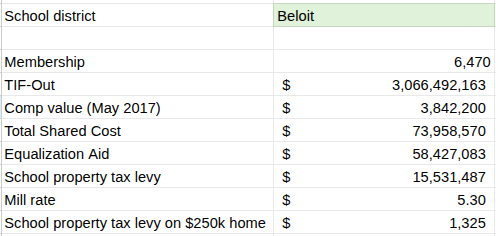
This is data for Beloit.
6400ish students. Side comment: why on earth does the state refer to students as “members?”
“TIF-Out” is the property valuation in the district minus any valuation in TIDs.
Total shared cost is the school district’s budget.
Comp value (May 2017) is some static number set back in 2017.
Equalization aid is what the state provides toward the shared cost.
School property tax levy is the difference between total shared cost and equalization aid.
Mill rate is the tax rate per $1000 of assessed value.
Now let’s look at what happens when you add $1B in a shiny new hyperscale data center.
Important note
The current year's state aid spreadsheet calculates a number lower than last year's actual when using the same input (ie new construction = $0). In order to make the comparison fair, I recalculate the baseline equalization aid and school property tax revenue using the state's forecasting spreadsheet. This allows a fair apples-to-apples comparison. The baseline and the two scenarios are now using the same calculation for equalization aid and the only variable is construction. If I do not make this adjustment, then any difference created by a change in state calculation from last year to this year will create an unfair comparison between scenario and baseline.
Adjusted baseline equalization aid for this community is $57,654,481. Adjusted school property tax levy, assuming the same total shared cost of $74M is $16,304,089. Those are the numbers to compare data center scenarios.
This isolates the new construction variable.
It also makes the end result less negative, in case you think I’m cherry-picking data to make a case. Comparing to actuals as a baseline makes the deal look really bad.
Scenario - $1B in new valuation
The state provides a spreadsheet that simulates the recalculation of state equalization aid. There are 3 inputs:
Student count
Total spending
Total valuation
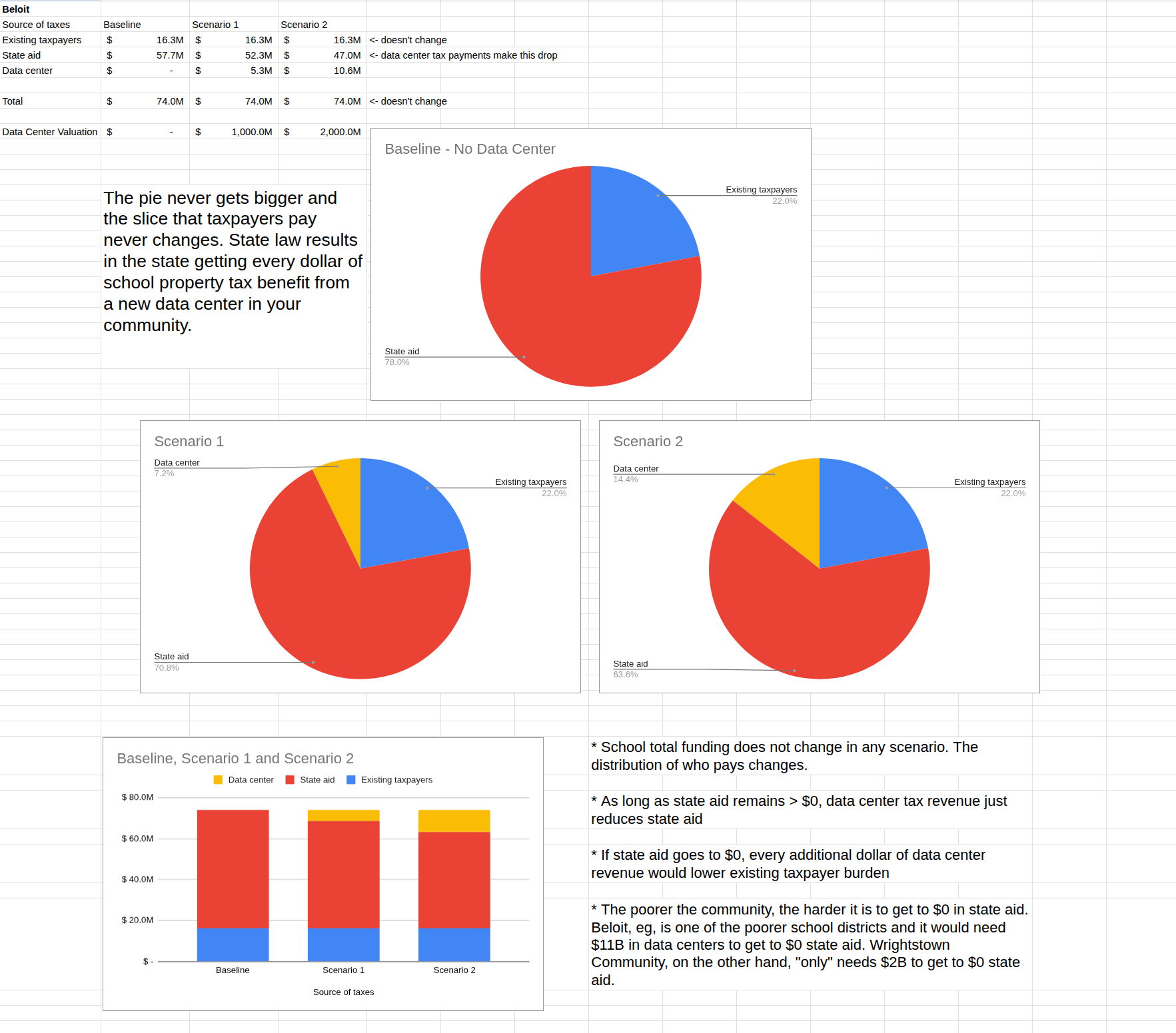
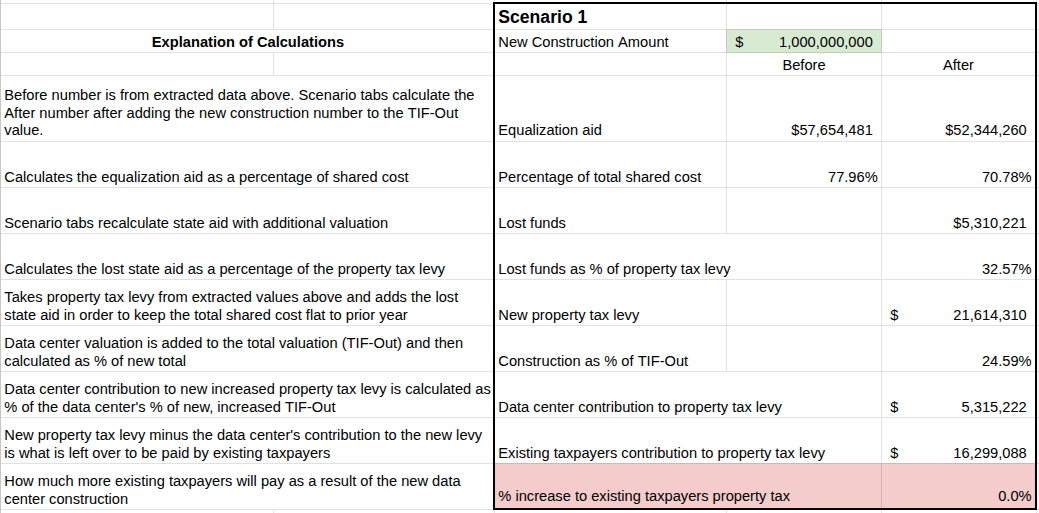
I hold the first two constant and add $1B to the total valuation and the state’s spreadsheet says that Beloit’s state aid would drop from $57.6M to $52.3M because the school district looks richer. Valuation/student is the proxy for relative wealth. That’s a 34% decrease in state aid.
To make up the difference and keep spending flat, the school district needs to increase the property tax levy to $21.6M.
There is a rich new taxpayer in town, though, so we need to calculate their share of the new property tax levy. The $1B is 24.59% of the new valuation total, so the data center is going to pay $21.6M * 24.59%, or $5.3M.
That leaves $16.3M for the existing taxpayers to pay. The baseline property tax levy was $16.3M. That means FOR EVERY DOLLAR OF NEW TAX REVENUE FROM THE DATA CENTER, THE STATE REDUCES EQUALIZATION AID BY $1.
Remember, too, that the school district has not increased its total spending at all. It can’t raise spending because of the data center. Only more kids and the per year inflation adjustment allow that. Shiny new data center valuation is not a variable in the calculation.
NO BENEFIT TO THE SCHOOL DISTRICT.
NO BENEFIT TO TAXPAYERS.
FOR EVERY DOLLAR OF TAX PAYMENT FROM THE DATA CENTER, THE STATE REMOVES $1 IN STATE AID.
Here’s the spreadsheet if you want to try it for your own community - https://tinyurl.com/widcstateaid

Why isn’t anyone doing the math?
This problem. The TID problem. The non-TID scenario. Levy calcs. School levy limit calcs. Did anyone do any math on these deals?
Mayor Dark Clouds in Port Washington was a principal and school superintendent. He’s been in education in Wisconsin his entire adult life. Doesn’t he know how this works?
Mayor Miss the Marck in Beaver Dam was a teacher. Same question.
Best municipal finance help in the state. Same question.
Best legal advice in the state. Same question.
Joint Review Boards approving TIDs have a rep from the school board. Same question.
Hold them all to a higher standard. The taxpayer catches all their mistakes. Nobody’s looking out for the taxpayers.
Visual Representation of Scenarios
Shocking provocative conclusion:
State law causes the state to get the benefit of a large new taxpayer in your community