Pineville, Oregon Case Study
Prineville Oregon might be the perfect case study for small towns contemplating large data center proposals. In 2010, Prineville was selected as the location for a new data center for Facebook. Then in 2012, Apple announced that it too would be building a data center on 160 acres of land in Prineville. Both have been actively building there since their respective announcements, over a decade later.
Some statistics on Prineville:
2000 population: 7356
2010: 9253
2020: 10,429
2025 (estimated): 12,078
Data center jobs in Prineville: 400
Construction jobs at Facebook site daily for a decade: 1000
Property tax paid by Facebook and Apple since arriving: $0 thanks to 15-year tax abatement
Tax dollars foregone by local govt per year due to tax abatement as of 2024: $29M
There is growth in Prineville. It's even causing some housing stress as new construction can't keep pace with demand, causing prices to rise. However, while it looks like the data centers are generating economic development, it's really the construction of data centers that is doing it. Steady construction for 15 years *is* the industry that is generating the growth. It's the consistent and known future construction that attracts construction workers to the city and that creates the indirect impact. As long as that treadmill keeps turning, the current level of employment can be maintained.
Unfortunately, what is created -- data centers -- have very limited employment and when the construction stops, what happens to the community then? The construction workers will not stay. They will move on to the next place of employment. The 400 data center jobs, even though they are high wages compared to the area, just aren't and won't generate a lot of indirect economic benefit.
And here's an aerial view of Prineville. It's easy to see where the massive data center campuses are. It's equally easy to see how 15 years after construction started, there is zero nearby development. The only economic activity that data centers attract is more data center development. Is there a non-obvious reason for the lack of development near the data centers that is unique to the location? Perhaps. It is curious, though, that the same effect can be seen in West Des Moines, Iowa, home of a long-running Microsoft campus buildout.
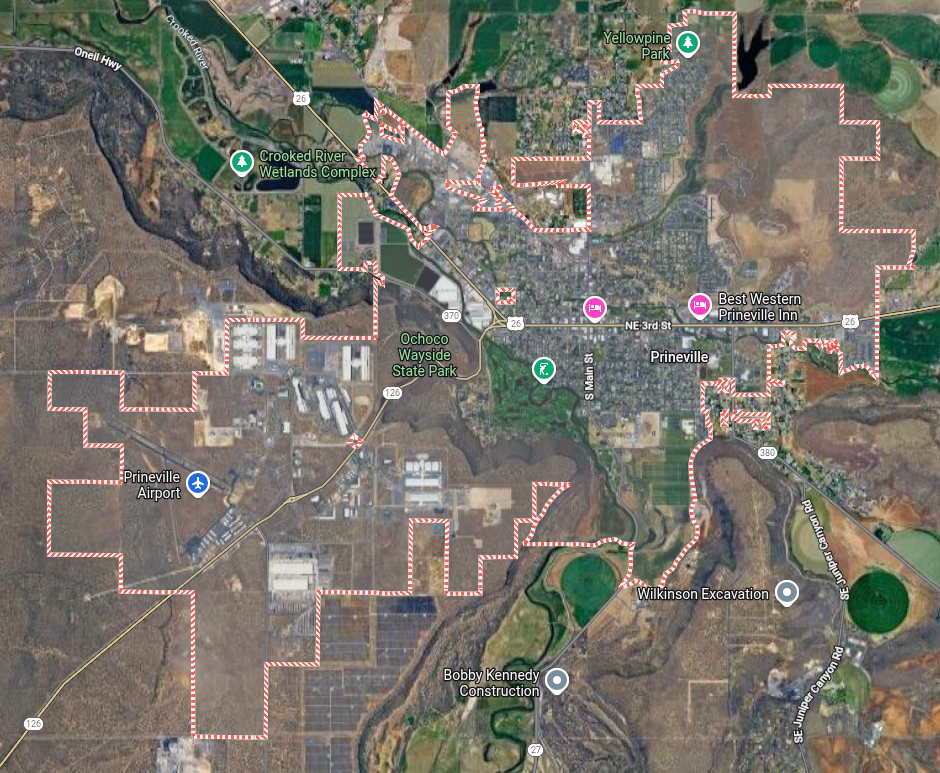
Prineville has seen $2B in data center development over the past 15 years, still gets no tax revenue from Meta or Apple, and has 400 permanent jobs to show for it. Has it been beneficial to a community reeling from its traditional employers failing or relocating? Sure. The town seems to have been in a bad place after the 2008 financial crisis. Maybe it was the right decision for them given their unique circumstances. Other small communities chasing growth with lucrative tax credits, though, might want to assess the case study of Prineville to determine whether it's the right move for them, or at least for a dose of reality about the claims of residual economic development benefit.
https://goodjobsfirst.org/the-cost-of-tax-breaks-on-oregons-public-schools
https://www.edcoinfo.com/blog/facebook-data-center-prineville
https://www.oregonlive.com/silicon-forest/2014/05/facebook_says_its_prineville_d.html
https://kbnd.com/kbnd-news/local-news-feed/138097
https://www.opb.org/news/article/prineville-oregon-facebook-data-centers-economic-problems-housing/