
Now that we know that Port Washington has the worst data center deal in the state, let’s take a look at another: Beaver Dam.
First, the developer agreement
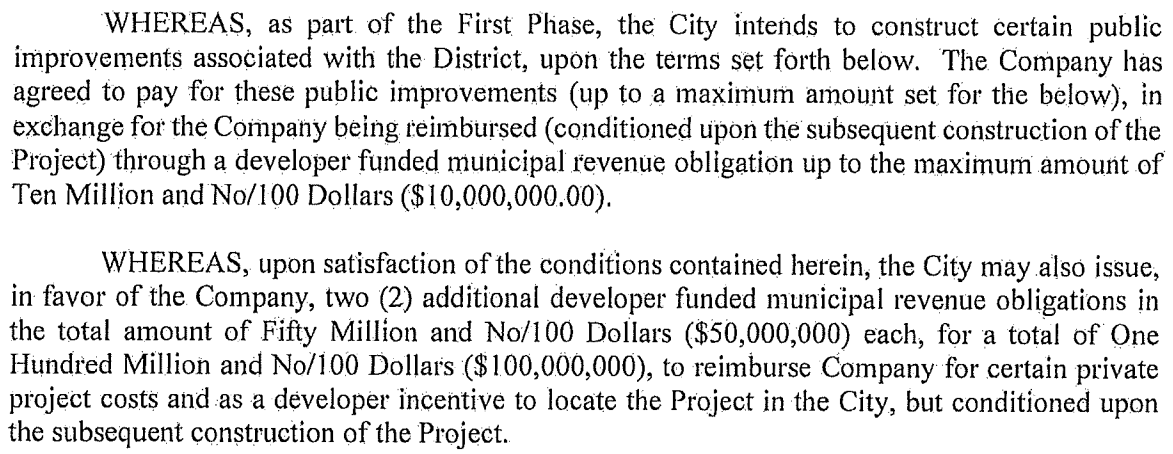
Cutting out all the distracting words from the agreement language in the image, the text reads:
"The Company has agreed to pay for these public improvements ... in exchange for the Company being reimbursed." Really, it says that. "I will pay, you will pay me back, and then I will brag that I paid." Phase 1, reimbursement is $10M. Phase 2, it's $100M.
The $10M is for the public improvements, ok, fine. But the $100M is "...for certain private project costs and as a developer incentive to locate the Project in the City."
…because "the City [of little ol' Beaver Dam] believes that unless the City provides the incentives to the Company, the Company will not undertake development of the Project in the City." Trust us, says the big company, this tech business is rough, whereas making a living in Beaver Dam is like Easy Street.
And that's how big corporations extort little towns to pay to have big corporations build in their community. “It’d be a shame if I just walked away.” And so the Beaver Dam city council approved it.
Maybe the benefits are so good they couldn't say no. Let's look:
The TID
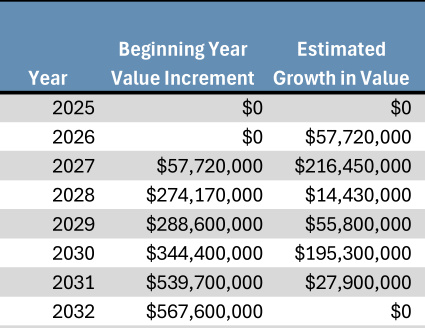
The standard TID project plan document starts with a revenue plan (new buildings = new valuation = new tax revenue, or tax increment as the cool kids say). Here's what Beaver Dam's says.
$57M in 2026, tax on which first gets paid in 2028.
then a big slug in 2027 of $216M
then a couple of smaller years
then another big slug of $195M
then the remaining $28M in 2031
Six full years of construction
$567M in valuation total
No break in the action
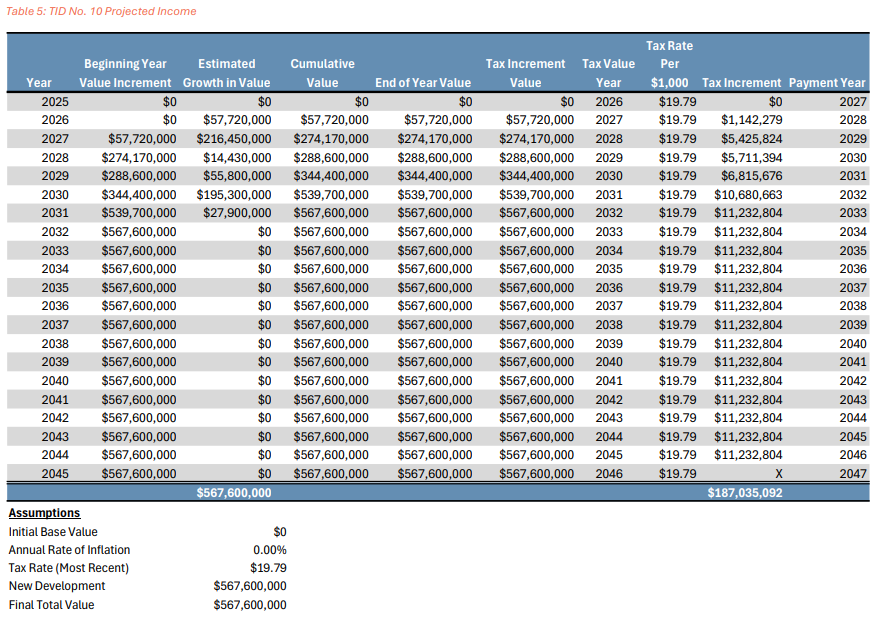
The tax revenue also gets a schedule that lines up with the construction schedule. Each tax year is as follows:
2027: $1.1M
2028: $5.4M
2029: $5.7M
2030: $6.8M
2031: $10.7M
2032 and every year thereafter: $11.2M
Before you Beaver Dammers (btw, just what is the right way to identify a resident of your fair town? Beavers? Dam Beavers? Dam Beaver Dammers?) start planning your summer town party, remember that it's TID money, not your money. You can't touch it until the TID closes. Let's look at the "money page" where costs and revenue are put together. It will show us when the earliest possible close date is. There’s a pot of gold awaiting you.
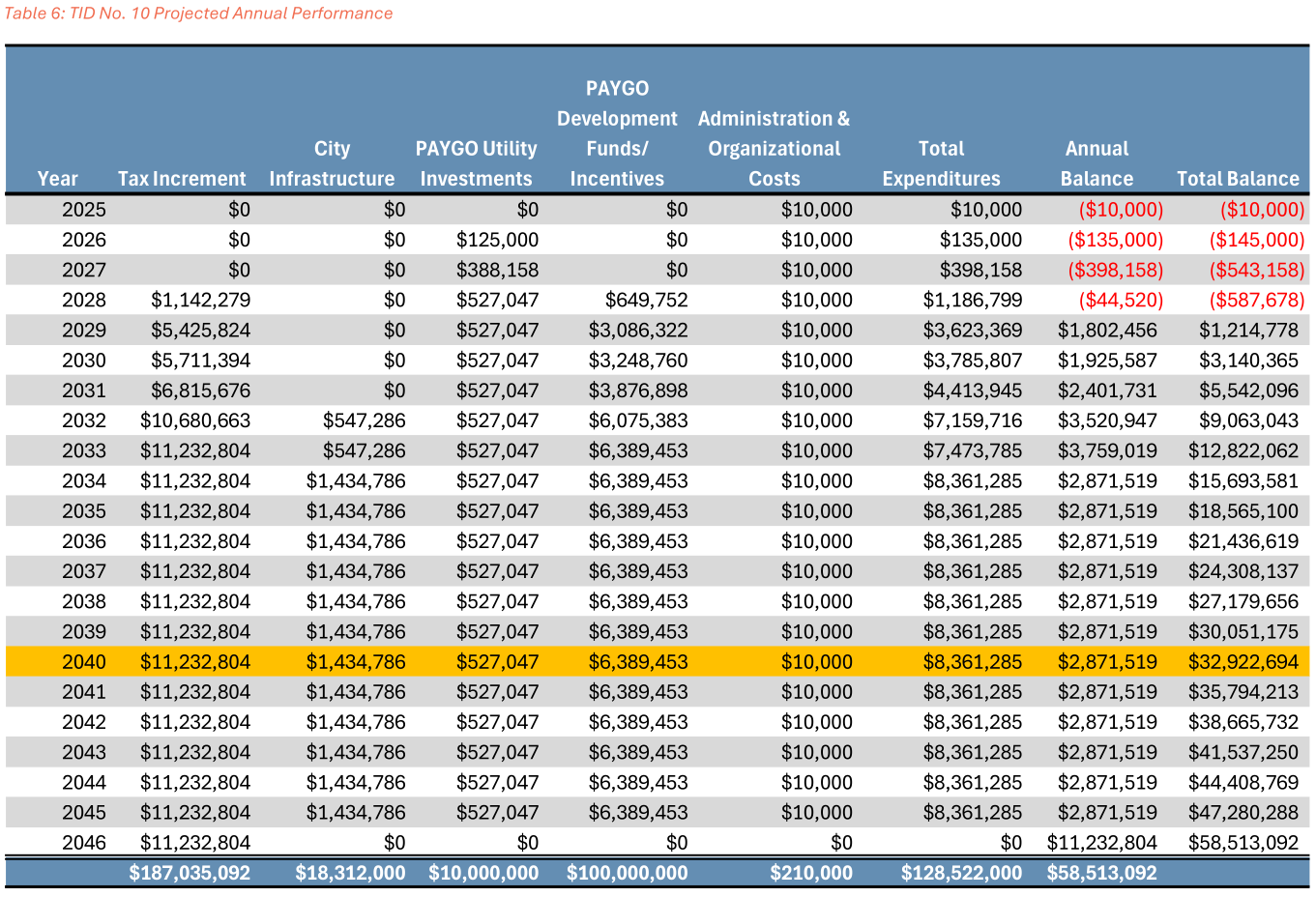
If you aren't a numbers nerd, the first column after the year is the amount of tax payment the TID gets every year (the revenue). The next 4 columns are the TID's expenses. Take the revenue, subtract the expense, and you get an annual balance. Red means expenses exceeded revenue. Black means revenue exceeded expense. Black is good. Red early on is expected.
A TID can close when it has met all its obligations. In this TID, you have two sources of obligations:
1) $18M of city infrastructure
2) You promised Meta $110M in tax reimbursements.
This TID’s balance goes positive early, but it still has to pay Meta that $110M. To calculate earliest close date, you have to find the year where the remaining Meta obligation can be covered by the positive balance in the far right column. By my calculation, that is 2041.
But column 1 is “building year” not payment year. Buildings added to the tax rolls in 2041 get their first tax payments in calendar year (or payment year) 2043. So 2043 is the earliest calendar year it can close.
A Closer Look
Red flag #1 is the smallest number on the page -- $10K year in city costs. This is a professional firm that put this proposal together. The word Professional is even in their name. Here's what you have to believe for that number to be true:
Protecting yourself against one of the biggest tech firms in the country who spends more on lawyer lunches than you spend on legal services all year will not need more than about 20 hours of high-priced legal advice all year.
The city will be able to manage their side of a multi-year project building $567M in new valuation with a couple of hours of employee time a week.
Current staff has enough idle capacity for inspections, disputes, open records requests, amendments to agreements, and any other issues that will happen early and often to simply absorb the work with no additional help.
This number is small and even adjusting it much higher doesn't change the TID performance that much, but it screams we are in over our heads.
A Whopper of a Problem
On page 13 of the currently published TID document, the tax rate that is used to calculate tax revenue from the deal is shown.

Then on the next page, you can see they take the projected new valuation produced and multiply it by the tax rate of $19.79 from page 13. Total tax revenue over the life of the TID is $187,035,092 on the total building valuation of $567,600,000.
Always check the assumptions. Then check them again. Below is a tax bill from one of your largest taxpayers in town.
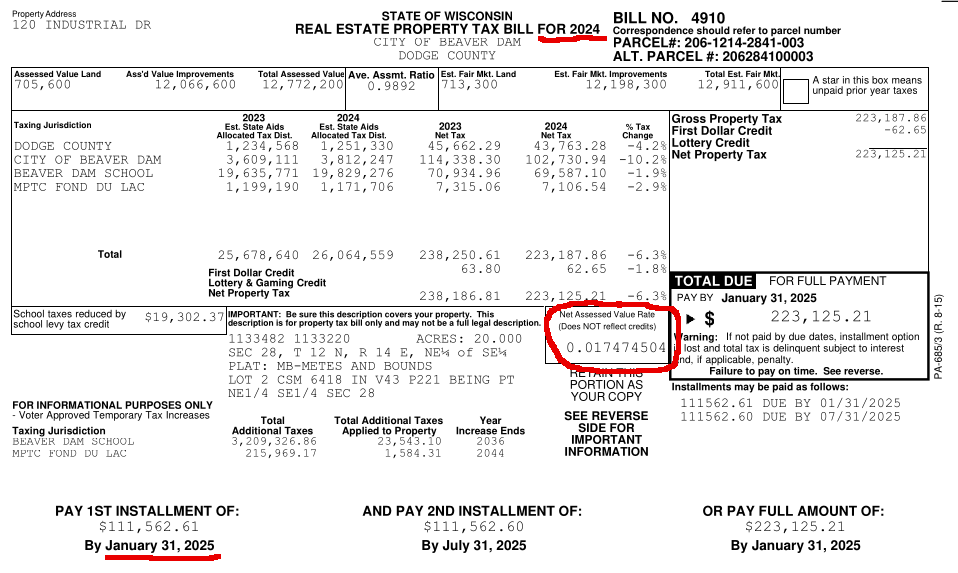
First, let’s get the dates straight: this is the 2024 tax bill and payments are due in 2025. Those bills are mailed out in December 2024. Since calculating and printing tax bills isn’t instantaneous and requires some care to get right, you can assume the data to support their production is available at least a month or two ahead of final production.
The TID was approved in late November, 2024. The tax rate for the coming year would have been known at that time.
The tax rate in the shown bill is 0.017474504. Expressed as “mill rate” to compare to the number used in the assumptions, that’s $17.47. That’s an 11.7% drop in the tax rate from 2023 to 2024.
If the tax increment column is recalculated with the rate of $17.47 instead of the assumed $19.79, the total tax revenue in the TID changes quite a lot. It drops from $187M to $165M, almost $22M.
Beaver Dam’s deal with Meta, however, is for a fixed dollar amount of tax reimbursement: $110M.
With less tax revenue to pay that obligation, it will take longer to pay it off. Doing the math on that, the TID will have to stay open for 2 more years before it can fulfill its obligations. That means the earliest calendar year it can close is 2045 instead of 2043. That is not a small problem.
The professional firm residents’ taxes pay for didn’t catch it. The city administrator didn’t catch it. The economic development director didn’t catch it. The city council didn’t catch it. When you do big projects, mistakes are amplified. This was a simple mistake that should have been caught. Would it have still been approved with the longer schedule? Maybe, but it highlights the hazards of chasing big tax revenue numbers and not really having the expertise to do so.
Final Comments
Please note that Beaver Dam is protected against getting stuck with debt. If the developer walks away the developer still has to pay the outstanding debt.
They do not have to do phase 2, though, and if they don't these numbers will be quite a bit smaller.
Port Washington's deal still wins the award for worst deal, but this one is a close second, perhaps only second by virtue of PW’s being much larger.
And suffice it to say, if Beaver Dam wasn't funding $100M of "certain private project costs" the financial benefit would be large. In fact, a TID wouldn't be required and Beaver Dam could happily borrow the $10M in infrastructure costs and pay it back with new tax payments in a couple of years.
Lastly, it's still hard to see why a municipality would do this with the developer incentive: permanent jobs are limited, obsolescence risk is high, revenue benefits are far away, concentration risk is high when they do arrive, legal risk is high, and indirect economic benefit is weak. It's easier to argue that the developers should be paying the city to use the land rather than the other way around.
Beaver Dam gets the award for worst turn of a phrase: "The Company has agreed to pay ... in exchange for the Company being reimbursed...." You just can't beat that, even if the terms of the deal are slightly better than Port Washington's.
The error with the tax rate is inexcusable. It’s a fundamental assumption in any TID and the TID was approved as tax bills with the new tax rate were going out in the mail. No one caught it. Beaver Dam residents pay handsomely for the expertise to define and manage a TID. None of that high-priced expertise caught that fundamental error.