Aesop wins again
Mayor Dark Clouds of Port Washington writes in one of his city’s FAQ’s on the data center project:
”The proposed data center project is a generational opportunity to help ensure the city’s longterm fiscal health, add capacity to invest in future projects and amenities that enhance our quality of life, significantly rebalance a property tax burden that right now falls disproportionately on the shoulders of our residents, and attract more visitors and residents.”
Let’s look more closely, again…

The mayor proclaims that without growth of the tax base, the city of Port Washington will suffer the problem of inflation eating away at the purchasing power of his general fund. The data center project represents a unique opportunity for him to vault Port Washington into the 21st century, delivering the economic freedom to build a world class city of tomorrow. But upon closer review, the Mayor has miscalculated a bit.
For the last 8 years, PW has averaged $25M per year in net new construction (NNC), the number that is oh so important to the calculation of next year's general fund tax levy. No NNC, no tax levy increase. Inflation, you say? Too bad so sad. That $25M works out to be 1.47% of the city's total valuation. Not bad, but not enough to keep up with inflation -- those are his dark clouds on the horizon. My oh my this treadmill is brutal. We're running as fast as we can and we're only producing 1.5% per year! What shall we do?
I know. Let's go get a massive data center deal. We'll get a bucketful of NNC, probably more than we can reasonably use, and we can raise the levy as much as we freakin' want for at least the next decade. The citizens will put up my portait in city hall.
Unfortunately, the mayor must not have mapped out the impact to his general fund or to the tax bills because the what if scenarios don't look good for residents.
Let's give the mayor his assumption that the city has to do something other than stay at 1.5%. Let's say instead of a data center project, though, the mayor and city staff go old school and do boring old development, trying hard to improve that 1.47% per year to 2.5% per year, just enough to keep pace with inflation. A restaurant, a new roof, a few boring warehouses, maybe an office building or two to get to $43M per year instead of $25M. A stretch for sure, but maybe doable.
Now let's take a random tax bill with $2K in city taxes. Currently, $1K of that is debt service, and we'll assume that stays the same for the next 20 years. The other $1K is the part the mayor wants to help. If PW manages to achieve 2.5%, then the tax bill of $2000 in 2026 will rise to $2639 in 2046. The total tax paid to the city in that time period by that tax payer is $48K (far right column). $2000 to $2639 seems like a hefty hike, but it’s not bad at all for 21 years. The mayor gets slow and steady growth of the general fund, the taxpayer gets a mild increase in tax bill every year, everybody’s moderately happy because hey, it’s taxes and nobody likes taxes.

Now let's look at the data center scenario. We'll assume the mayor keeps delivering the current $25M per year in net new construction through projects other than the data center, and we'll layer in the forecasted new valuation from the data center -- $568M in '26 and '27, and $488M in '30 and '31. Here's the mayor's first problem. State law makes you use the NNC when it hits the tax rolls or you lose it. You can spread it out over 5 years, but whether you increase the levy once or in five increments, he's going to have to use the increases long before the TID closes in 2046. (Not sure what a TID is? Look here.)
Looking at the simple view of taking it all when it hits the tax rolls, here's what happens to the same taxpayer's $2K tax bill, $1K of which is for debt service and stays static and the other $1K is the part that gets hit with the increase.
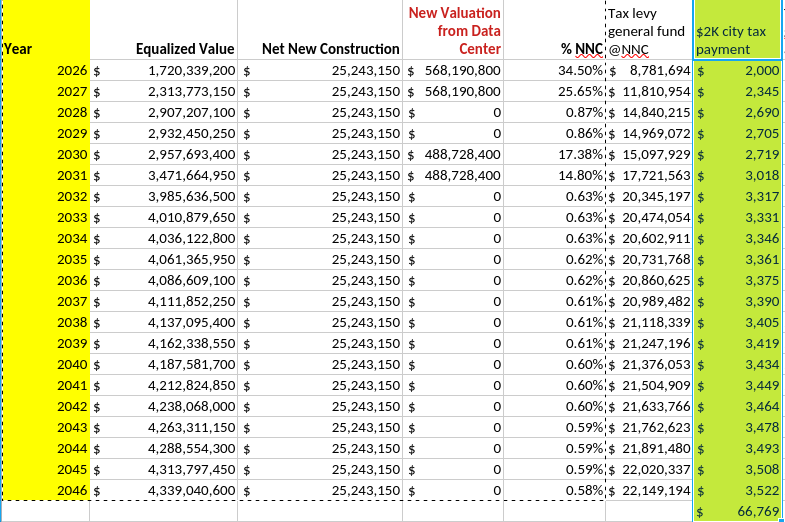
So in the steady 2.5% scenario, total tax burden for the taxpayer is $48K. In the data center scenario, the total is $66K. While shocking to see this delta for a project that purports to be "for the taxpayer" it's not new analysis here. The provocative statement has already been made: local officials want these projects so they can raise your taxes not lower them.
And recall, all this increase happens to existing taxpayers because the developer producing all that net new construction is still keeping its dollars in the TID, "paying itself back with its own tax dollars" to use the mayor's words from his infamous flyer.
The city council can and probably will limit the increases so that the residents don't buy pitchforks and charge city hall over a 34% increase in 2027, for example, but whatever they do, they will reach a new valuation and budget plateau after 2031 when phase 2 is done. When they reach that plateau, the city's total valuation will have risen from $1.7B in 2026 to $3.9B in 2032. Yay! Er, wait, maybe not yay.
Here's where the mayor failed to calculate and he actually puts himself in an even bleaker position. Repeating, he's socked it to current taxpayers to raise the levy where he wants/needs it, wherever they decide to draw the line. But now that the city has settled into its new budget, the data center owner is still 13 years away from contributing to the general fund. And the mayor's enemy -- inflation -- slowly eats away at purchasing power again.
What the mayor misses though is that his standard $25M per year now only produces a paltry 0.63% NNC. No raises for the cops and firefighters for a while I guess. The NNC treadmill just started moving a lot faster.
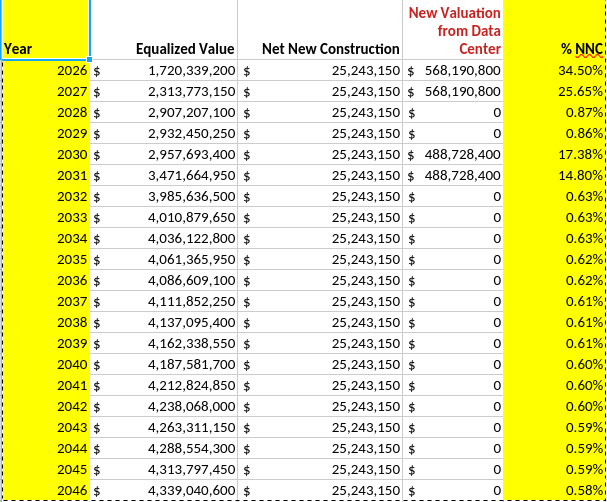
The mayor's silver bullet solution backfires as soon as the data center buildings go on the tax rolls. He worsened the problem he was trying to solve, and he socked it to the taxpayers in the process.
Remember the story of the tortoise and the hare? Well, it's still true. Mayor Dark Clouds is running fast like the rabbit when he should be pursuing slow, steady, and sustainable growth.
This problem will exist in EVERY small community in WI. And while it will be much worse for current taxpayers where a TID is used, it will also impact those small communities where no TID is used. The new valuation will overwhelm the community's total valuation and it will prevent that community from ever realizing meaningful increases in its budget after the data center construction is done. Those small communities will have their budgets nearly completely frozen for decades. Absent legislative relief, they will have to do what they don't want to do now -- go to referendum for more money. And imagine the embarrassment of signing your town up for a data center project on the promise that it solves all your financial troubles and then a few years later having to go to referendum for a bailout?
And if you want read about another city making the same mistake, go here.