He has doubled down, quadrupled down, and now is octupling down. Let’s break down Mayor Dark Cloud’s claims in his end-of-year assessment.
TL;DR - the mayor is contradicting himself badly. He either doesn’t understand how TIDs and levies really work, or he can’t connect some simple dots that spell trouble for the residents’ tax bills over the next few years. If he raises the tax levy while the TID is open, the current residents’ tax bills will rise. How many more Port Washington residents would be angry if they knew the mayor was using the project to raise their property taxes? If he doesn’t raise the levy when the construction occurs, he loses the opportunity to do so and there is no general fund benefit to the city. He’s trying to convince you that he can have it both ways. He’s woefully wrong.

Let’s give the Mayor some kudos for admitting what really drove his terrible deal with Vantage. Go to this link and listen to the description of this first bullet point.
https://www.youtube.com/live/IGGMAAWJgAk?si=R_wAD7Zw4ySi2GYX&t=3190
He admits that he’s constrained by state law from raising the levy without net new construction.
He claims that residential construction volume is not allowing him to raise the levy enough to keep up with city needs. “Our revenues cannot keep up with the needs of our city.” — Mayor Dark Clouds in his own words.
He won’t say it this way, but this provocative statement is thus true:
The mayor wanted this project so that he can raise your taxes, not lower them.
The question every Port Washington resident should be demanding of their mayor is:
Can you raise the tax levy (total collected from all taxpayers) without raising MY taxes?
And the answer is No, and the mayor has to know this. As long as Vantage is paying taxes into the TID any tax levy increase will have to raise current residents’ tax bills.
For proof, just visit Mount Pleasant, as described in this article. The mayor said in his presentation that he went to Mount Pleasant and took home lessons learned from them, so surely he understands the conundrum he faces when the first building hits the tax rolls in Mount Pleasant.
As an aside, your county will be faced with the same conundrum. They too will have big whopping net new construction from the data centers that hits the tax rolls, and they too will be tempted to raise taxes, and Vantage will not contribute to that increase either. You will.
“Worked with a group of bi-partisan legislators … to protect Port Washington”
He’s referring here to the data center exemption to the 12% rule. The 12% rule states that the total projected valuation to be added to the tax rolls in all the TIDs in a municipality cannot exceed 12% of the city’s current valuation. The mayor helped lobby for a data center exemption to that rule so that he could do the deal with Vantage. It otherwise would have been precluded. 12% of PW’s 2025 valuation is about $206M and the data centers are projected in the TID project plan to be greater than $2B.
Why does the 12% rule exist? Well, primarily to prevent so much new construction from occurring in TIDs. When that new construction happens, it is added to the tax rolls and allows the city to raise the tax levy but the taxpayer who built the buildings doesn’t contribute to those tax increases until the TID closes in 20 years. If the city raises the levy from that new construction, it is only the current residents that will bear the brunt of that increase. When the new construction is a single percent of the total valuation, your tax bill would rise a single percent. When it’s 20% of total valuation, your tax bill would rise 20%.
In other words, the 12% rule was designed to protect the residents of a city. Mayor Dark Cloud’s lobbying to remove that rule does exactly the opposite of protecting Port Washington, unless you think Port Washington = city council vs Port Washington = its residents.
Removal of the 12% rule puts the city residents at high risk of large tax increases as the massive net new construction hits the tax rolls. It does, however, make the city council’s annual budgeting process easier as they will have incredible latitude to tax the bejeesus out of its residents if they want to.
The only factual part of the mayor’s claim here is that the vote was bi-partisan. Both parties happily voted to remove the taxpayer protection of the 12% rule.

“The city is not paying for anything, and Vantage is paying all the costs….”
And then there’s this nugget from the city’s myth-busting flyer:
“[Developer] will pay up front for infrastructure improvements that benefit the entire city. [Developer] essentially pays itself back for infrastructure improvements through property taxes they pay….”
As recently articulated by a local politician who actually understands how TIDs work:
"I realize it's TID money, but TID money is real money."
Yes, Mr. Mayor, if you are letting Vantage forgo $450M in tax payments, the city actually is paying for something.
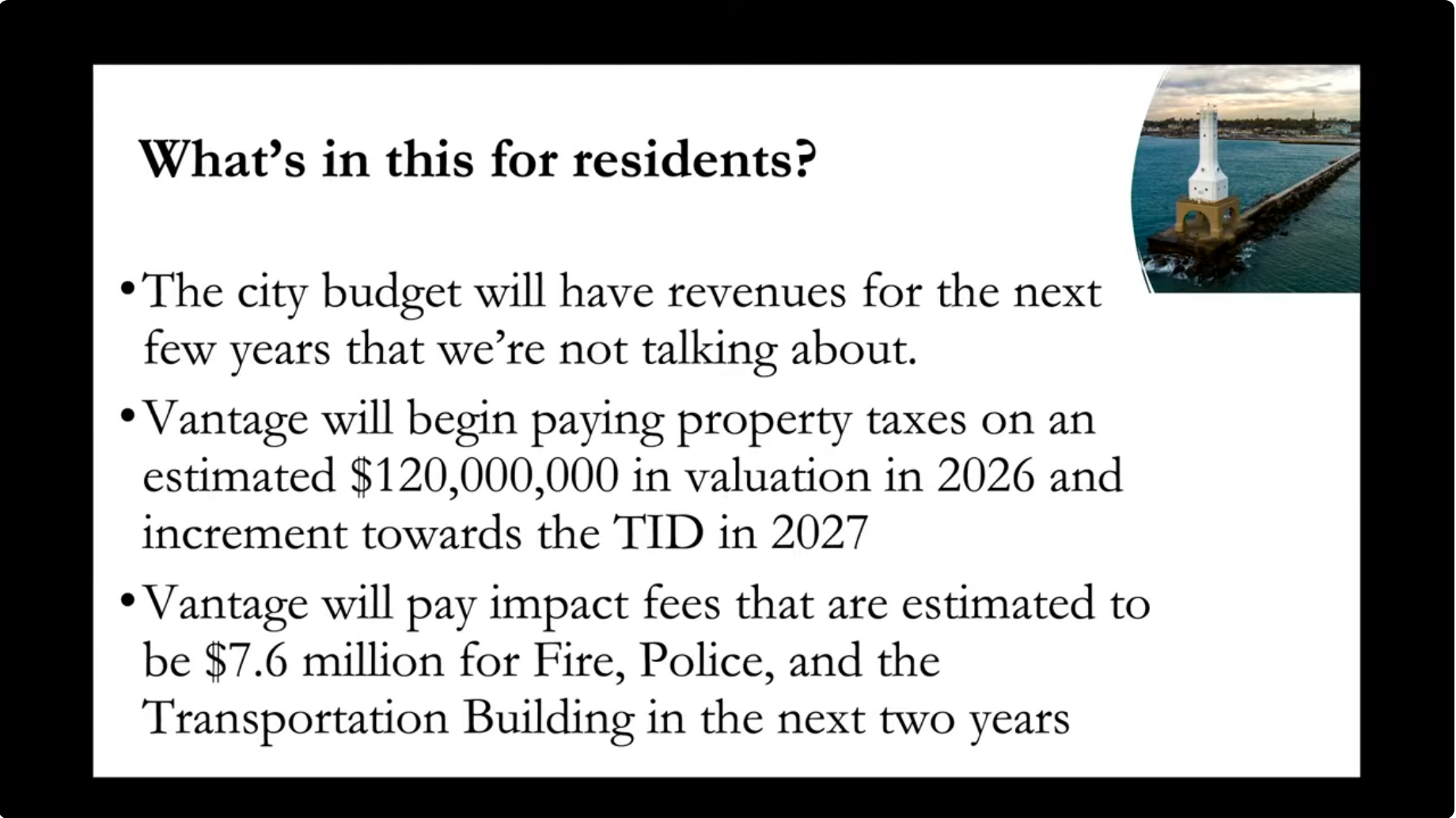
What’s in this for the residents?
$120M in new valuation
This is true! Unfortunately, he neglects to say what the tax revenue is from that new valuation, likely because the $120M number sounds big and lucrative. The property though is “unimproved” meaning it has no building on it, and unimproved properties don’t generate a lot of tax revenue.
Trying to back into it, the first property listed in the TID document has a currently assessed land value of $29K and produces $281 in tax revenue. That’s right, two hundred and eighty-one dollars.
The $120M is a 17x increase over the sum total of all the properties in the TID.
If that one parcel created 17x its current tax revenue (for all 4 taxing authorities, btw, not just PW), then that 1 property would start producing $4817.
That one parcel is 88 acres, which is 5.5% of the total acreage.
$4817 / 0.055 = $87K.
Is that the right number? Dunno.
Or how about $120M * net assessed value rate of 0.0136444 = $1.6M * 42% = $670K for City of Port Washington.
What is the number, Mr. Mayor? You surely have an estimate of that total and the distribution to the taxing authorities. Just tell people the truth. If this is about new tax revenue, tell them the tax revenue.
Vantage will begin paying … increment towards the TID in 2027
…and he implores you to learn what that means. Well, here’s what it means, again using his own words from his infamous flyer:
“[Developer] will pay up front for infrastructure improvements that benefit the entire city. [Developer] essentially pays itself back for infrastructure improvements through property taxes they pay….”
So what’s in it for the residents? The mayor has allowed them the magnanimous gesture of reimbursing Vantage $450M over the next 20 years.
Impact fees of $7.6M
Maybe we should start with defining impact fees. Wisconsin Statute 66.0617 says this:
“Impact fees are cash contributions, land, or other valuable items imposed on developers by a municipality”
and that “Shall bear a rational relationship to the need for new, expanded or improved public facilities that are required to serve land development.”
So Mr Mayor is boasting that Vantage is going to pay for stuff that their massive development project requires the city to do to support said massive development project. Woohoo.
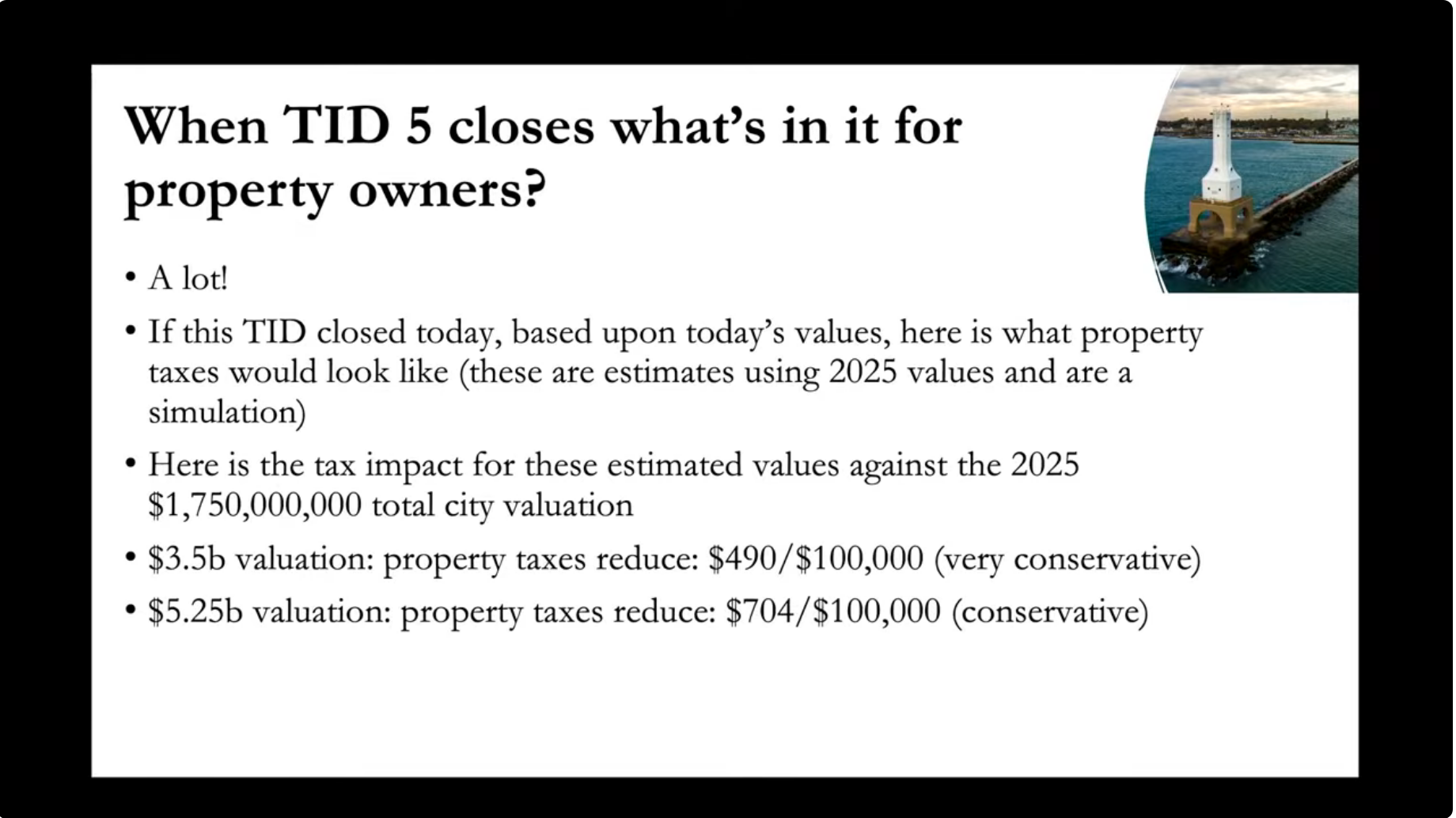
If TID 5 closed today…?
Well it won’t close for 20 years, so what good is describing the impact of it closing today?
But let’s go with that thought.
If you closed it today following the shortest multi-billion dollar construction project ever, your taxes would drop precipitously! But the mayor leaves out the tiny little fact that his scenario assumes the tax levy has not changed from current levels.
And why is that important? Well… recall why Mr. Mayor wants to do this project in the first place. Again, in his own words: “Our revenues cannot keep up with the needs of our city.” So if he doesn’t raise the tax levy and lets your property taxes drop, what has the city gained? Has the city solved its tax levy problem? No. The mayor is contradicting himself badly here.
So if he wants to raise the levy to pay for more city services, he has to take advantage of the new construction when it hits the tax rolls. And it hits the tax rolls when Vantage is still enjoying paying itself back inside the TID. And thus the increase in the levy that the Mayor himself proclaims is the reason for doing the project is paid for by the citizens, not Vantage … FOR THE NEXT 20 YEARS.
Then when 20 years is up and Vantage is ready to contribute, your tax bill, which have been inflated for 20 years to cover the increases, will definitely drop. Yay!
Which is it, Mr. Mayor:
we’re keeping the levy flat and in 20 years everyone’s taxes drop a lot
we’re raising the levy while the TID is open and socking it to current taxpayers for 20 years
You can’t have it both ways.
And finally, some miscellaneous observations from the rest of the show:
The chastising councilwoman used as an argument against the TID referendum that “people get busy with real life and can’t pay attention to the details.” Recall the mayor’s criticism of residents “just not paying attention to what was going on with the data center project.” Maybe get your stories straight?
And Mr Data Center Councilman objected to the lifespan of data center criticism saying he has worked in data centers older than 20 years. Well, there’s nothing like an N of 1 to prove a point. 6% of data centers are 25+ years old. Yes, we keep building lots of new ones which increases the denominator, but it if were strictly a denominator effect, the total capacity in data centers older than 25 years wouldn’t also be 6%, but it is. Reference here. Obsolescence for a data center means the cost of upgrading exceeds the cost of building new, or that the size of the older facility is too small to justify the fixed costs of the building. There are myriad other risks as well, including the risk of valuation decrease in the future to water down some of those eye-watering tax revenue numbers. But hey, what looks too good to be true is for sure true in this case.