Open letter to Wrightstown
To whom it may concern in the Village of Wrightstown,
Before you dive in to the world of hyperscale data centers, let's take a closer look into the financial side of the deal. That number on a sheet of paper that shows the tax revenue from a campus of buildings is likely quite eye-watering, but thanks to Wisconsin state law, getting that number into a levy increase or a taxpayer bill reduction requires some thought and planning. There are two communities in our state with approved projects, Beaver Dam and Port Washington, who wanted tax levy increase from the deal and will not get it because of the way they financed the deal. Imagine the regret.
Who am I?
My name is Prescott Balch. I live in Caledonia WI. I am a retired technology professional, working most of my career in the financial services industry. In summer of 2025, I had a data center proposal appear in my community. After some analysis, I joined the group that had formed to resist the proposal and we were successful in convincing Microsoft to withdraw. Our reasons to resist were unique to our community and I don't pretend they all apply to you. I firmly believe we need data centers. I would be a hypocrite if I argued we should stop building them now that I am retired. It is where to build them that is the challenge. Since resisting the proposal in my own community, I have been helping other communities understand the risks and rewards associated with data centers. Often, it is just the rewards that are communicated. My goal is to help paint the full picture so that each community can decide for itself whether they wish to proceed.
Apologies in advance that this letter is long. The topic is complex and difficult to explain. For those of you who prefer something a bit less dense, please see the references at the end of this document for links to other sources.
Throughout this article, I will be using output from this spreadsheet. It isn't perfect, it makes some assumptions. It has to hold some variables constant. But it's decent at showing the tradeoffs from the decisions that you make about the deal terms.
But first, let me define some terms you'll encounter below that may be foreign to you.
Mill rate - the amount of money per $1000 in value that you pay in property taxes. It's the same thing as tax rate, but multiplied by 1000 so that it looks like dollars and cents and not a number with five digits after the decimal point. Wrightstown's current mill rate is $6.73, so if you have a house worth $250,000 then your village property tax will be 250,000 / 1000 * 6.73, or $1,682.50.
Tax levy - the total amount of property tax collected. Each individual property owner has a tax bill. The village collects them all and calls the total a tax levy.
Background village numbers
Your village's total real estate valuation is $570M
Your average annual new construction over the last 8 years is $42.6M, or 4.5%
Your village mill rate is currently $6.73
Your general fund property tax is $2.8M per year
I have not seen any forecast for Wrightstown's total new data center construction, so I used the latest forecast from Beaver Dam, both schedule and valuation. Regardless of what your town's proposal eventually looks like, the example will provide a view of how decisions and numbers interact with each other.
TID
TL;DR version: do not, under any circumstance, use a TID to finance a data center project. The interplay of levy calculation law, TID law, and the scale of the project will put you in this impossible situation:
If you want levy benefit, you will have to dramatically raise taxes on current residents for the duration of the TID.
If you hold current residents' taxes flat, you lose the opportunity to raise the levy.
You cannot get the value out of the project that you went into it planning to get.
Say that over and over again: if you use TID, you cannot get tax levy benefit out of the project.
Given that Port Washington and Beaver Dam have made this mistake just learn from them and don't use tax increment financing.
The other benefit of not using a TID is that it forces the data center developer to pay for their own municipal infrastructure. Tech companies don't need tax reimbursements. They need open space and proximity to power. If you have those two things, you have all the leverage.
Analysis of Port Washington TID
Beaver Dam's mayor doesn't know how TIDs work
Port Washington's little TID problem
The non-partisan Wisconsin Legislative Council admits TIDs raise taxes
Here's the longer version...
The construction in a TID counts toward the levy calculation in the year that the construction hits the tax rolls. Unfortunately, when you take the opportunity to raise the levy because of the construction, the taxpayer in the TID doesn't contribute to the levy increase. Their tax payments are stuck in the TID. Only current residents get to pay for that levy increase. This is how all TIDs work, but no one usually notices because the TID construction as a percentage of a village's total levy is usually very small. Data center construction, though, is not small, and it's the scale that turns this problem into quite the spectacle.
Let's say you are eager to do the data center deal to both increase the levy and to provide property tax relief for your residents. I modeled what that would do to your mill rate, and it isn't pretty. State law allows you to take 90% of the construction into the tax levy calculation as the construction hits the tax rolls. In the table below, I modeled 50% of the construction being used in the levy increase calculation. Recall that if you raise the levy from TID construction while the TID is still open, it's just your current taxpayers that bear the burden of the increase. And because the data center construction is a massive percentage of your current valuation, the increases are sharp and certainly noticeable. The table below shows the mill rate going from its current $6.73 to $10.58 to $13.11 until year 20 when the TID closes and the mill rate drops back to current rate.
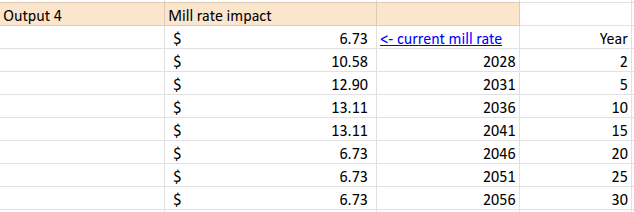
In plain English, if you are using TID and you take just half of the new construction to raise the levy, your current taxpayers' village taxes will more than double and will stay doubled for the duration of the TID.
In even plainer English, if you are using TID, ask your residents if they are ok with their village property taxes doubling because of the data center. They will of course say no. They will not tolerate doubling of their property taxes while the TID is open. When the TID closes, state law does afford you the opportunity to increase the levy by 10% of the total construction that happened while the TID was open. That increase raises the levy but does so without impacting current residents' village property taxes. If all the levy increase you get out of the project is 10% of the value of the construction, will you think the project was successful? Several hundred acres, little to no employment, no indirect economic benefit ... for a 10% increase in the tax levy after a 20 year wait. That is the regret that Beaver Dam and Port Washington are both currently facing because of the way they financed their deals.
Growth Rate Impact
Wrightstown's growth rate over the last 8 years is quite impressive. The average community grows 1.4% per year using the state's net new construction levy calculation. Wrightstown averaged $26M in new construction, which is 4.5% of current valuation. Wrightstown is doing more than fine on its own growing organically.
An often overlooked impact of the get-rich-quick project of a data center is the impact it has on that growth rate. Beaver Dam's forecasted new valuation for its data center campus is $1.4B. If that same valuation were to happen in Wrightstown, and if Wrightstown continued to produce an average of $25M per year in organic (non data center) new construction, the organic growth rate would drop to 1.2% after the data center construction was done.
Why is this important? Communities are chasing data center construction as a way to solve their levy growth problem. The state gives you one variable to solve for to raise your levy -- net new construction. The levy increase calculation is new construction divided by total valuation. Yes, when the data center construction happens, you get a short-term eye-watering levy increase, thanks to a huge numerator. But the current year's numerator gets added to next year's denominator, making future growth much more difficult. Wrightstown's growth is robust and steady. Why ruin it with a massive data center project?
And if you know you are consciously headed into a period of more difficult growth, then you are going to make different decisions in the short term about levy increases from data center new construction. That is, you are going to be inclined to take as much of the levy increase as possible knowing that inflation is going to erode your purchasing power as you struggle to grow at the rate of inflation after the data center is built.
No TID
This is where the financials start to look attractive. Of course, they aren't risk-free, but we'll come back to that after looking at the numbers.
Assuming again that the village's goal is 50% of the tax revenue going toward levy increase and 50% toward tax bill reduction of current residents, the village mill rate drops from $6.73 to $4.72 with the first construction phase, then eventually to $4.21 where it stays. Lower mill rate means lower tax bills, in case that's not obvious.
Please note, however, that if you choose to lower the mill rate you are also lowering the mill rate for the data center. Whatever they are forecasting for future tax revenue for the Village of Wrightstown should be discounted accordingly as their calculation is based on your current mill rate.
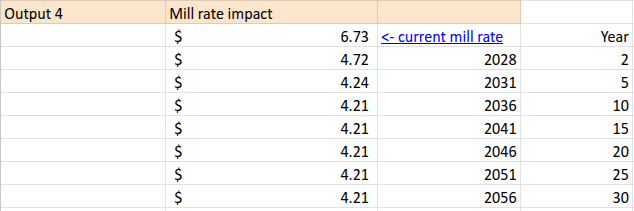
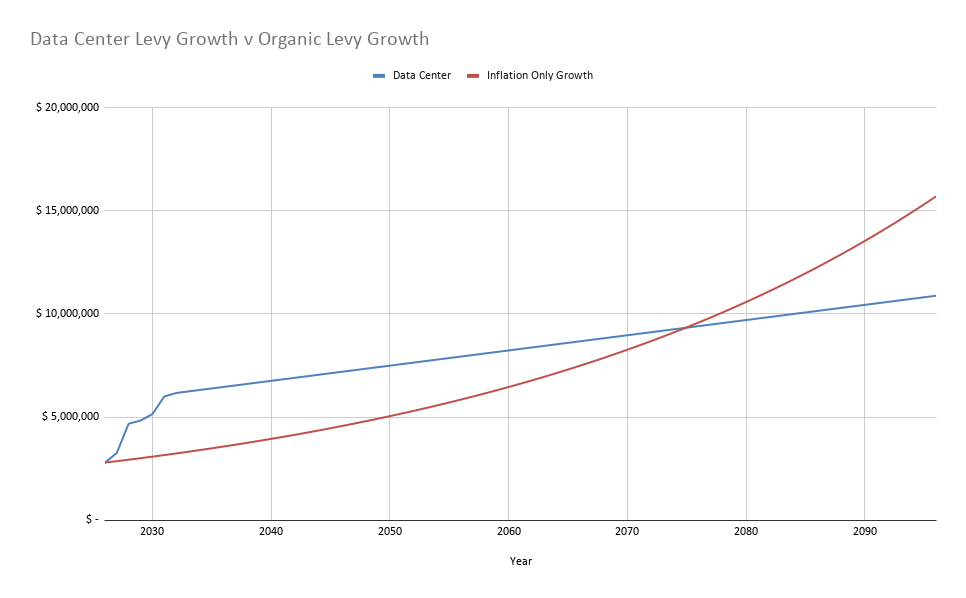
Likewise, your tax levy rises from $2.7M to approximately $6M, an embarrassment of riches. The graph below shows growth of the levy with the data center project (blue) and growth of the levy with only organic new growth equal to the rate of inflation. Trying to fairly represent the pros and cons shown in the graph:
Inflation only growth eventual overtakes the data center model
...but it takes 49 years
The excess tax revenue collected between now and 2070ish, if managed well, could put the village in superb financial shape for decades
...if managed well across all elected boards and appointed staff
There are many plausible scenarios that can alter the blue line, all of them for the worse
Many of the negative impacts are manageable … with discipline
What you will do with the abundance of tax levy now becomes a very important question. Applying little or no foresight to the decision, you will be inclined to fund all those projects that have just missed being funded over the last decade or so. Even if those projects have new operating expense, you will be swimming in money.
Perhaps you will also aggressively pay down your debt, which by the way will also lower your existing taxpayers' bills, assuming you have some debt to pay down.
Then what? Keep slowly increasing spending until you get used to the new $6M? Hold expense far lower and save the money in a rainy day fund? Maybe even decide in a few years that you have more than enough and you cut the levy closer to actual needs. Of course, if you do the latter, state law doesn't allow you return it to prior levels without more new construction, and with the large new denominator of equalized value that the data center delivered, you won't be growing that much. Your incentive will be to take as much levy growth as possible, and from there, the goal should be to practice as much financial self-discipline as possible: hold spending to just above current levels and bank the excess.
Why should you try to save a potentially large amount?
The Risks
Let's start with the big one: financial concentration risk. Using Beaver Dam's projected valuation as a proxy, this one taxpayer will make up over 70% of Wrightstown's tax revenue -- one taxpayer, in one industry that prides itself on disruption and reinventing itself constantly.
If you managed your retirement portfolio with that kind of concentration risk, your financial advisor would call you irresponsible. If your financial advisor advised you to do it, you'd fire him.
State law dictates that idle taxpayer funds be invested in the safest of financial instruments, such as Treasury Bonds. While that state law does not extend to the management of future tax revenue, the underlying philosophy for the law is that taxpayer money should be managed hyper-conservatively. Very low risk is good. No risk at all is better. You are on your own, though, with decisions you make about future tax revenue. Ask yourself if you want to put your village in that situation, no matter how eye-watering the near-term benefits are.
Then if you still want to proceed, ask yourself what can go wrong and A) can we tolerate it, or B) can we mitigate it?
So what can go wrong?
In the worst case scenario, your data center owner has significant financial problems and stops paying abruptly. Odds of this are very low, but impact is very high. Given the impact, it would be wise to have a plan.
Data center owner challenges valuation. At 70% of your total equalized value, it does not take much change in the valuation of the data center to become a noticeable increase in current residents' tax bills
Here's a link to a recent example of a successful valuation challenge that reduced valuation by $20M, causing a $700K reduction in tax revenue - https://dmainc.com/news-and-insights/700k-in-property-tax-savings-for-payment-processor-data-center/
Pay special attention to this text [emphasis added]:
The initial assessment aligned the construction costs of the data center with its market value. While this approach is fairly common, it did not fully account for factors such as rapid technological obsolescence, the specialized nature of certain components, and excess capacity, resulting in a valuation that did not reflect current market conditions.
Let's say you are at a $6M levy, $4M of which comes from the data center. Assuming a 25% valuation reduction, you are about to lose $1M in tax revenue. You could drop the levy $1M to keep everyone's individual tax bill the same, assuming you have successfully put aside a very large rainy day fund. That fund would allow you to continue to spend at the same level in the short term before deciding how to react to the change. However, if you do drop it, remember that Wisconsin state law makes that your new baseline. You can't raise it again without the new construction. And remember, the giant valuation denominator you now have in the levy calculation is making it hard to grow. This is how concentration risk manifests itself -- a small problem with the one big thing becomes a big deal that requires careful foresight and planning.
But if you leave the levy at $6M, your existing taxpayers, who are 30% of your tax base, have to make up the $1M. That's a 17% increase in their tax bills (1/6 = 0.167).
Listing some of the other industry changes that could result in valuation challenges or worse:
The AI data center buildout is commonly thought to be in a bubble similar to the dotcom bubble of the late 1990s
The technology industry relentlessly innovates, regularly discarding old technology for new
AI software improvements reduce data center capacity needs
Repurposing the buildings to a use with lower valuation
Technology is an industry which takes pride in constant change, disrupting even itself let alone other businesses. At 70% of your property tax, this is more a marriage than a date. This one taxpayer will have outsized influence on your municipality. They will not have an attachment to your community through the people they employ because that number of people is so low. I've heard the lack of employment spun as a good thing -- "at least if they walk away, we'll still all be employed." While ironically true, the absence of a connection to the community through people makes for a very different relationship than a company with deeper community roots through people. As the theme of this letter goes, you can still want to do the deal, just know what you are getting into and protect yourself. The tech company will be protected.
Other concerns
Data center developers often overstate the direct jobs produced by data centers. Northern Virginia has 565 data centers, largest concentration of data centers in the country, and only 10,420 direct employment jobs. That's 18 per data center and obviously that's a statistically significant sample size.
Data centers produce no indirect economic benefit. The small number of permanent jobs are easily absorbed by the economy of even small towns. Supply chain businesses do not relocate to be near a single data center campus. The 'multiplier effect' that economic development professionals talk about only works at scale. With the employment numbers of a data center, the multiplier is zero.
You will be outmatched in the negotiations with the developers and the tech company. You don't know what you don't know. You might not even know who to hire to help you.
The tech company behind the deal is both important and not. The tech companies with consumer-facing businesses will care more about their public perception and you will retain some leverage over time. Other tech companies have less concern and may not have any concern over public perception. Even if you are dealing with one more concerned with that perception, nothing stops the tech company from selling the data center later. You need to protected against both ends of that spectrum.
Your future growth will also be constrained by the land use for this data center. You only get so many chances at annexation. Choosing this project for an annexation commits a very large amount of land for growth that is unproductive -- minimal permanent jobs, no indirect economic benefit. Yes you get a large tax revenue stream for some time, but the project produces nothing else for the village. Good economic development begets related development. This is not good economic development.
Data centers attract other data centers. Do you want that? Do your residents want it?
Data centers are purpose built. The risk of abandonment is low, but at least assess what you would do with a million square feet plus of purpose-built data center space if that risk came to pass.
Construction of the data center is heavy industrial and years long. Zone data centers accordingly. Don't put them in light industrial even though that might seem appropriate for the long-term use. How long does heavy industrial construction activity need to last before you consider it when zoning?
Final thoughts
I've analyzed proposals and communities whispered to have a proposal across Wisconsin: Caledonia, Port Washington, Beaver Dam (2), Greenleaf, Mishicot, Deforest, Cassville, Janesville, Mount Pleasant, Kenosha, Beloit, Wisconsin Rapids, and Menomonie. I've also analyzed proposals in Minnesota, Illinois, Ohio, and Michigan. All of them are unique, but all have this pattern in common: the smaller the town the greater the risk. As I led with, I'm a retired technology professional. I think we need data centers. I'm not trying to talk you out of saying yes. I'm trying to educate you on the risks that you are obligated to protect your residents against.
References
Link to this document - https://tinyurl.com/wrightstowndc
Wisconsin data center site - https://www.widatacenterfacts.org/
Data Centers in Small Communities - https://docs.google.com/presentation/d/1rO1VkE3l4a1N9BRNNP76J6zoQ-5zeGO5vBT3GqTqcOA/edit?usp=sharing
Voice over for slides in previous link (30 mins) - https://www.youtube.com/watch?v=RAPwa2DO-uQ
Pros/cons spreadsheet - https://docs.google.com/spreadsheets/d/1HZZ9kVQebA7nt6Wi0M5xE8t7qHhojFJg3kOoE4VtQ-c/edit?usp=sharing